
History behind Drive Coolers
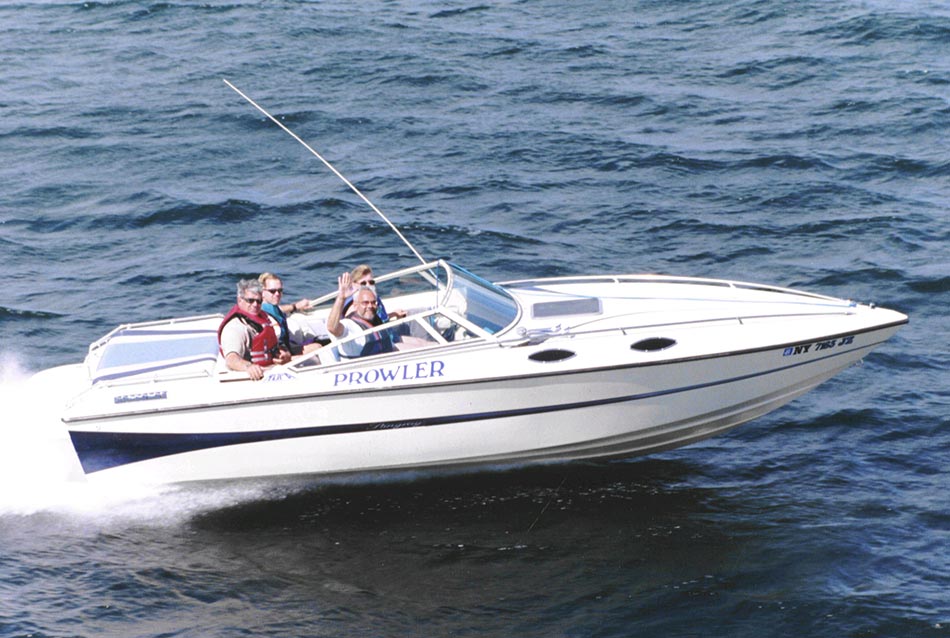
In 2000, Simrek® also introduced the 90 degree pick-up port. This also sent many of the other manufacturers scrambling to come up with a solution for their products. To minimize costs, some choose to do nothing. Even after the 45 degree pick-up ports were tested and the results of their failures were published, they are still using this system on their products. You can still find pictures in various magazines of a boat with one of these 45 degree drive coolers and it is obvious by the picture that the drive cooler is not spraying any water onto the drive. One guy tried to circumvent the US Patent by drilling the hole in the front of the tube but plugging only half of the bottom of the tube which picks up just about half of the water.
With the introduction of the Multiport Drive Shower® in 1999, the industry saw a 100% increase in the ability to cool a stern drive. Since then, many have tried to make improvements on our design but we remain the leader in the industry. There has however been the introduction of a lot of gimmicks to the market. Coolers that replace the top bearing cap or the back inspection cap with a very expensive and not very efficient cooling system are one of the worst gimmicks. They are closely followed by the “cap styled” systems that use: attractive finishes, elaborate designs and exotic shapes to entice you to buy one because it looks nice and should work even though they will offer little protection for your very expensive drive.
In early 2007, after learning that MerCruiser would no longer “look the other way” when it came to drilling holes in their drives to mount a drive cooler, we immediately developed our new “No Drill Bracket”. Mounting our showers without the restriction of utilizing a pick-up port system that must be able to be inserted through a hole drilled in the anticavitation plate; we soon there after developed our new Max System. They utilize two pick-up ports that do not have any sharp bend in the tubing and thus the water flow. Anyone that has used a garden hose knows that a sharp bend in the hose dramatically reduces the wafer flow. We took the most efficient drive cooling system on the market and improved it by an additional 10%. Other drive cooling systems offer about 25 to 35 degrees drop in drive oil operation temperature. Our new Halo Max provides 65 degrees of cooling protections. Plus installation is a snap; one bolt at the top and either 2 nuts or 2 clips at the bottom and in less than 5 minutes, you are done. Both the “No Drill Brackets” as well as our “Max System’s” pick-up port system is Protected by US Patent, Issue Date Feb. 23, 2010.
Before you buy any drive cooling system, ask to see the independent test results that documents that the system does what it claims to do. Don’t rely on the salesman’s redirect, your buddy’s opinion, “it looks like it should work” or claims made by the manufacturer. The proof lies in the ability of the system to cool the drive oil. Isn’t that why you are buying it in the first place? A blown drive with a pretty drive cooler on it won’t be of much value.
The new: “No Drill Brackets” and the new “Max Pick-up Port System” are both Protected by US Patent, Issue Date Feb. 23, 2010 Degree Pick-Up Ports US Patent Issue Date June 6, 2001.The words: “Simrek”, “Multiport Driveshower” and “Halo” are all Registered Trademarks of Simrek Corp. and may not be used anywhere in print without written permission from Simrek Corp.
Copyright © 1999 - 2025 Simrek Corporation