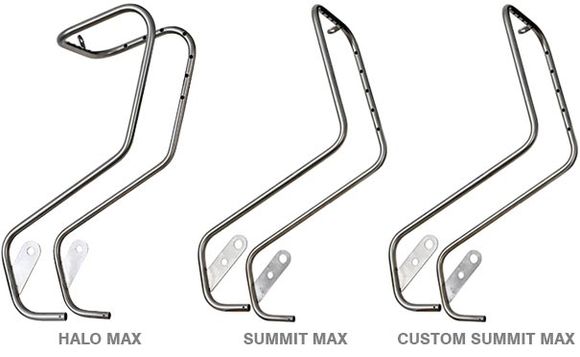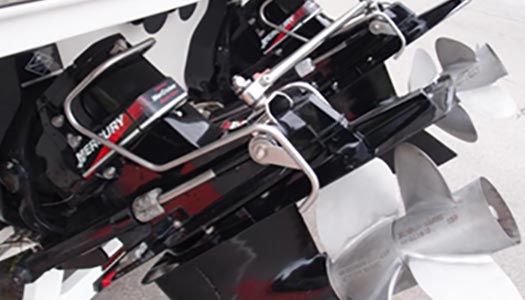
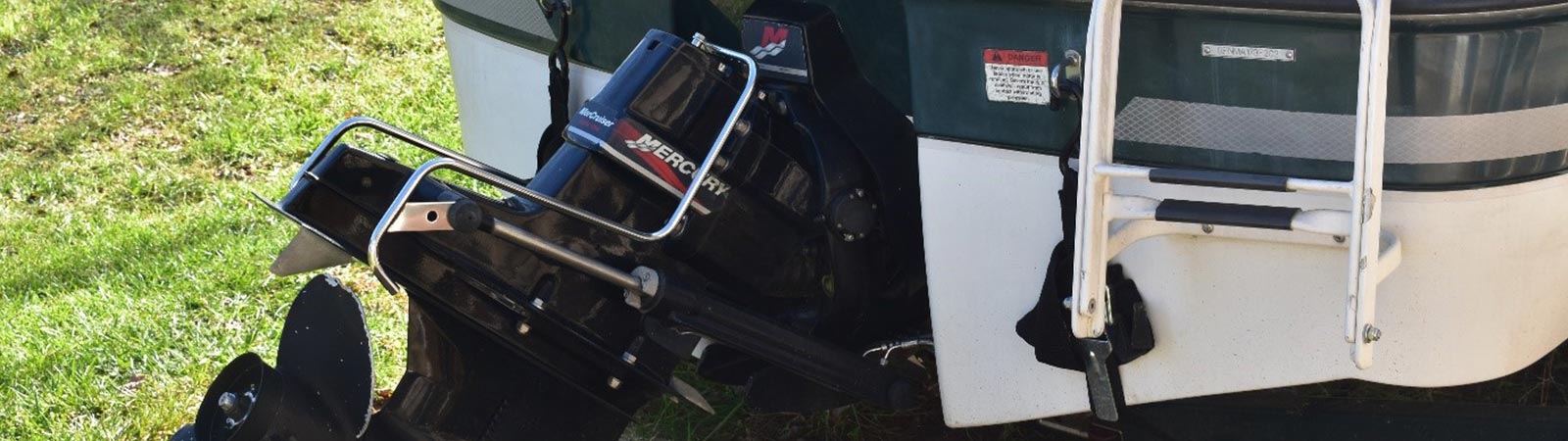
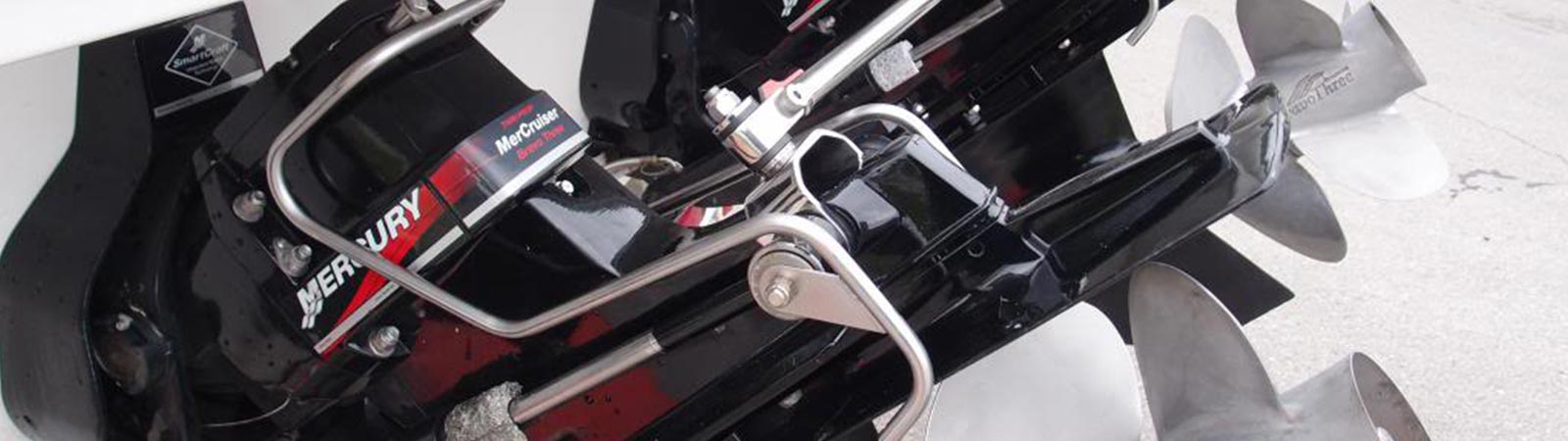
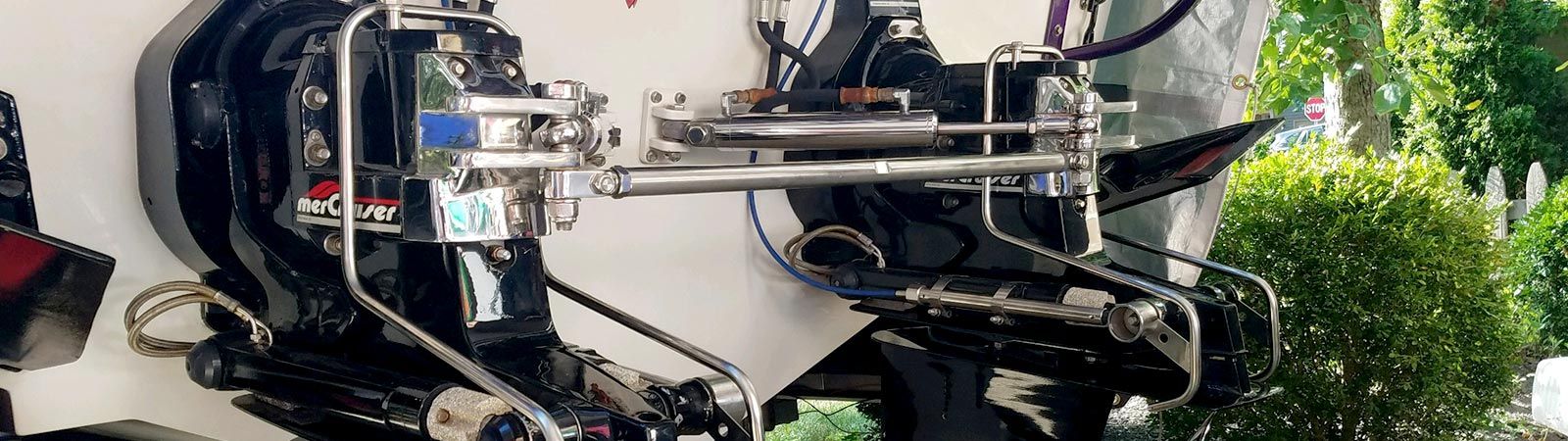
They may look similar to our Summit Design,
but you need to beware of these knock-offs!!

At this point there are five knock-offs of our Summit Drive Shower on the market (that we know about). Most of them are only feeble attempts to circumvent our US Patent. Some are in direct violation of those patents, so any product warrantee they offer will be short lived, All of them have created their own design flaws as a result of the gimmicks that they are trying to market as improvements to our design.

Designing a Drive Shower isn’t as simple as it might seem:

Besides getting maximum cooling of the drive oil inside the drive, a drive shower needs to not only process the water but also the debris normally found in the water. It has to stand up to the massive amounts of vibration caused by the stern drive, and it also needs to keep its shape and pick-up port location consistent and working at any trim angle. Getting all this to come together in one design took: a design engineer, a metallurgists, a very elaborate C.A.D program, years of manufacturing experience, exhaustive testing, and a lot of customer feed back. We are not a couple of yahoos with a tubing bender.

Consider a drive shower as a huge tuning fork. An example of a tuning fork is the metal thing that the doctor bangs on and then touches near the back of your ear to test your hearing. Only this tuning fork is three feet long (6 feet of tubing formed into a “U” shape). The same thing that causes the buzzing sound in your ear is the vibration that is constantly being exerted up and down the tubing of the drive shower, only at a much greater rate and non stop. This term for this vibration is called harmonics. If left unchecked, what it can do to ½ inch diameter tubing is amazing. It forms a crack in the tube that look as if someone ripped it apart like a piece of paper. Sometimes it takes less than an hour to crack the tube in half, sometimes it takes months. It will enlarge the mounting holes to a point where the cavitation plate is weakened and eventually the corner breaks off. Harmonics is by far the biggest hurtle to overcome while designing a solid tub drive shower system. I’m not seeing any consideration for the harmonics in any of the knock-offs that I’ve seen. So gimmicks like: adjustable pick-up port length, mounting the shower without drilling holes in the cavitation plate, adding a bunch of extra dump ports, and some others that I’ll leave proprietary, will only help to promote the destruction of the shower through the harmonics. You really do need to know a lot about Physics to design a shower that will not only work, but last.

There are very specific reasons why we designed every aspect of our driveshowers the way we did. We have had six years to develop our designs and work out all the bugs. We have already solved the problems with the welds failing, tubs cracking, prop cavitation, plugged ports, and corrosion. Some design improvements are proprietary and some I can share with you. I don’t want you to end up with an inferior product or get fooled into buying gimmicks that you don’t need and that will cause the product to eventually fail. Our biggest concern is that people will mistake these junk designs for our products and hurt the reputation that we have earned and enjoyed for all these years. If anyone could make an improvement to our design, it would be us. Yet these 5 copies of our Summit design all claiming to be improvements to our design. Some even have internal test results to “prove it”. Not only are they going to have to deal with the same problems that we had to overcome years ago, but their individual design changes are going to cause a whole new set of problems for them. So these gimmicks that they are offering are going to turn into your problems after the sale.

To give you some idea about how none of these guys have a clue as to what they are doing -- five years ago we came out with our Halo design which gets 20% more cooling than our Summit design, and yet they still keep copying our Summit. That tells us that they are all five years behind us. If we could put the Halo on an Alpha, we probably wouldn’t even offer the Summit. It’s now a very small portion of our sales. If they don’t have enough sense to copy the better of our two models, why would anyone think that they have enough knowledge about designing a drive shower to make “improvements to our product”?

There are reasons why we…

Have only one mounting bracket: First, you don’t need more than one. If we used two, you would have to remove two bolts from the bearing cap (or inspection cap for the Halo). That equates to removing 50% or more of the bolts that secure the oil seal. Knowing that one bolt is enough, we felt that it was better to disturb those seals as little as possible.

Use pins to locate the shower on the cavitation plate: The cavitation plate is not only made at an angle, but it is also a curved surface. If you try to mate a curved surface to a flat surface you will end up with a single point contact. If you use a pin you will get a two point contact. More contact means less stress. Also see: Made the dump-ports the size and configuration that we did.

Have the shower hugging the sides of the drive: It’s proprietary and I’m not yet willing to share.

Put 7 dump-ports on the Summit and 11 on the Halo (instead of more): If seven dump ports are good that 14 should be better, right? There is a condition in Physics referred to as, The Law of Diminishing Returns”. Think of it like this; if one bucket of water puts out the camp fire, how much good would it do you to dump on a second. During the design and testing phase of our Summit, we found that we only picked up an additional 3 degrees of cooling by adding the 7th dump port. To add an 8th port yielded and additional 2 degrees of cooling and the 9th, was less than one. Knowing that the more holes that you put in the tubing the more susceptible it becomes to cracking; we opted to minimize the defects even though it meant giving up 3 degrees of cooling. We sell 2000 drive showers per year. We look at it like this, a product that is works perfectly well 95% of the time equates to 100 angry customers. We are now operating at a 0.005% failure rate and we just made some minor changes to reduce it further.

Made the dump-ports the size and configuration that we did: We experimented with things like: increasing the number of dump-ports while reducing their size, to make them work more like a nozzle or jet. We also tried slots instead of holes to create a fanning effect. We thought that we had something revolutionary and it did test better than having a single larger hole. The problem came very clear to us during testing when those smaller holes became plugged with algae, and the other debris found in the water. Also, more holes weakened the tub which caused it to crack more easily. We even went one step further to make our design even less susceptible to plugging up, we took into consideration everyone best friend, the Zebra Muscle. The biggest advantage to our pick-up and dump port configuration is that anything that can get past the pin (which divides the pick-up port in half) can get past the bends and out the dump ports, even Zebra Mussels. So our system will not get plugged with debris. That’s the other reason that we use a pin instead of a sleeve to locate the pick-up ports. Are you beginning you understand why something as small as using a pin instead of a sleeve can make all the difference in the world when designing a drive shower?

Only put adjustable length pick-up ports on less than 5% of our showers: Sales of our adjustable length tips are actual very rare and are only used for specific applications like a tunnel hulled boat with speeds of 100+ MPH. The length of the pick-up ports is critical: It took us three years of field testing and listening to customer feed back to determine the best length for the pick-up ports on our showers. 3/8th of an inch too short and they don’t penetrate the pocket of foam found under the anticavitation plate and thus they will supply a minimal amount of water. 3/8th of an inch too long and they will cause the propeller to cavitate. Manufacturers that offer an adjustable length pick-up ports are counting on you to determine the best length for their pick-up port. We do not ask our customers to hang over the back of their boat at 30 + MPH to see if the shower is working, and we recommend that you don’t either.

Configured the pick-up ports the way we did: For the same reasons that adding more dump ports has a diminishing return, the same holds true for increasing the water volumes. We experimented with different shaped pick-up ports, larger diameter pick-up ports, and larger diameter tubing. Any increases in the capacity to cool the drive were minimal at best and invariable they had a detrimental effect on reliability and/or durability. Some designs even increased the amount of debris that was picked up, which would eventually render the shower useless. One of our early designs had a pick-up port with a 45 degree angle for the bottom of the pick-up port instead of the horizontal plug that we have now. The C.A.D renderings came back with a fairly substantial increase in water volumes. Wow, something that not only works better, but it’s cheaper to manufacture. There is one huge draw back to that design, and others like it: During the dreaded field testing, we found that the increased water volumes came with an increase in the amount of debris that got caught up in the upper portion of the shower. We found twigs, tree bark, and even a drinking straw that was logged so far up the tub that we couldn’t get it out. It seems that a longer soft item, like a twig, will bent enough to follow the 45 degree angle up the tub, but it can’t make the 90 degree turn it would need to make with our existing design and it simply gets carried away by the force of the water. The same debris build up problem happened when we tested what is now called by other manufactures as “The New 80 Degree Ports or the “New Ice Cream Scoop Ports. New?! We knew that those were bad ideas years ago. They may look like concepts that we overlooked, but we found them not to have enough benefit to out way the problems that it were causing, especially when you consider the “Law of Diminishing Returns” by increasing the water volumes.

Mounting a shower without drilling holes in the cavitation plate. Sounds good right? Click here to see why it can’t work.

A Warning about test results:

Never take the word of anyone doing their own testing. With no means of verification, it’s too easy to fudge the numbers, especially if you have a vested interest in the outcome. Even if your intent is to be honest, it’s way to tempting to say “well the gage was sort of close to the 260 degree mark and if we would have been going just a little faster, had more drag on the boat, etc”. We did a lot of our own testing but it was only used for internal purposes and we never refer to it in any public forum. All test results that we quote are from independent testing facilities that have been repeated many times. Some of our own test results have resulted in a much higher reduction in the drive oil operating temperatures than was found during the magazines published testing, but we always refer to the magazines (Hot Boat, Dockside, and Family and Performance Boating) results for marketing purposes. These articles are all available on this website. Credible testing can only be done by independent testing facilities and repeated with the same results. Here is an example: My wife’s minivan can do 0 to 60 in 2.5 seconds, and I’ve got test results to prove it. Want to buy it???? It would be one thing if I could produce NHRA time slips, but it probably won’t take long to figure out that it was just two guys with a wrist watch and both are willing to swear to it.

One way to offer a cheaper price is to have less costs:

In order to compete with us and offer a lesser price, these knock-offs are often made of an inferior stainless steel that is not fully resistant to corrosion or they use a tub design that will crack once exposed to the normal vibrations found in a stern drive.

Stainless steel tubing can be manufactured in a variety of ways and all of them have a cost associated with it. We could save 40% of our material cost if we switched to “rolled and welded” tubing, similar to most of these knock-offs. For durability reasons, we chose the more costly method of extrusion, often refereed to as seamless tubing. We found that the rolled/welded (and then) polished tubing may look better but with the vibrations found in a stern drive, eventually those welds will crack. So the look of a polished or “mirror” finish can come at a cost.

There are many different kinds of stainless steels and not all of them are completely corrosion resistant. One way to determine the quality of the stainless steel (without being a metallurgist) is to understand that the more pure the stainless steel is, the more resistant it is to accepting a coating or coloring. For that reason, we don’t offer our showers in colors and you should be wary of those who do.

Even though it looks similar, this is not a Simrek 90 Degree Pick-Up Port

This may look like our 90 Degree Pick-up Port but because the bottom is not full enclosed, it allows the water to escape without going up the tube. As a means of reducing manufacturing cost, we looked at this design when we were developing our 90 Degree Ports back in the year 2000. We found that only partially enclosing the bottom lead to about half the water volumes than with the bottom fully enclosed.


About Us: Simrek Corporation specializes in external stern drive cooling systems for your high performance or pleasure boating needs. Composed of high-grade  stainless steel, the Simrek Multiport Drive Shower® can add years of life to your Alpha and Bravo drives

Copyright © 1999-2007 Simrek Corporation, 137 Pacer Drive, Henrietta, NY 14467
E-mail:simrek@driveshowers.com   Phone: 585-334-0531 
Simrek Multiport Drive Shower® is a Registered Trademark by Simrek Corporation.
90 Degree Pick-Up Ports US Patent number 6,241,566 Issue Date June 6, 2001.